One politician whose silence has stirred intense speculation ahead of the 2027 presidential elections is former Senate President, Dr. Bukola Saraki. While many of his contemporaries have already declared their political alignments, the former Kwara State Governor remained unusually quiet until recently. His party, the People’s Democratic Party (PDP), appointed him to lead efforts in reconciling its aggrieved members.
However, this appointment has not gone without controversy. Observers note that Saraki’s emergence as the PDP’s chief reconciliator has further deepened internal crisis. Across several states he has visited, party members accused him of highhandedness, favouritism, and perpetuating corruption. In Kogi State, for instance, Saraki was accused of imposing his preferred candidate on the party, a move that drew sharp criticism from local stakeholders.
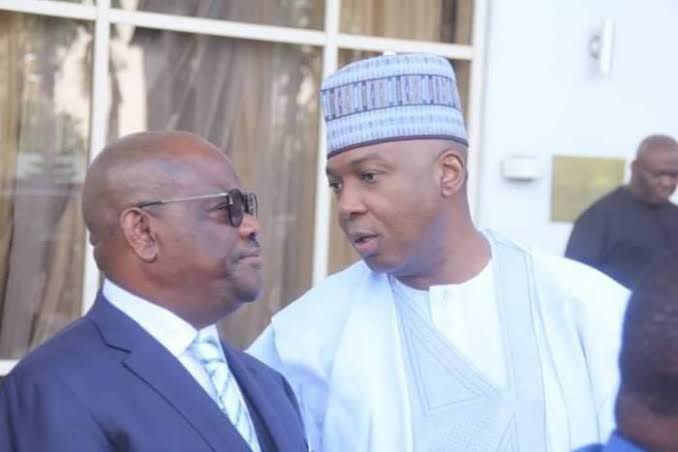
Contrary to widespread belief that Saraki’s initial silence was a calculated move to position himself for the PDP’s presidential ticket in 2027, credible sources suggest a different strategy. This medium has learned that Saraki has decided to back President Bola Tinubu’s re-election bid, adopting a strategy similar to that of the Minister of the Federal Capital Territory, Nyesom Wike.
In essence, Saraki plans to remain within the PDP but work for President Tinubu’s second-term agenda mirrors the role Wike and four other aggrieved PDP governors played in the 2023 elections. Sources close to the development revealed that Saraki’s decision stems from the slim chances he has winning PDP’s presidential primary election, a contest most observers believe will favor former Vice President Atiku Abubakar if his coalition negotiations hit the wall.
Saraki’s political shift was evident during the recent joint session of the National Assembly. Invited by Senate President Godswill Akpabio, Saraki was present when President Tinubu delivered his June 12 Democracy Day address. During his speech, the President dismissed claims of trying to establish a one-party state and criticized the PDP for accusing him of engineering its internal crises.
Interestingly, while Tinubu openly castigated the PDP and other opposition figures accusing him, Saraki was seen laughing and even applauded the President after the session. According to insiders, his presence and visible alignment with Tinubu’s rhetoric are strong indicators of a burgeoning political alliance between the two.
Sources also suggest that had Saraki not agreed to this strategic alliance, he risked political isolation. With a slim chance of securing the PDP ticket and having fallen out with Atiku who has now chosen Bolaji Abdullahi, a former Saraki ally, to lead his coalition in Kwara State, Saraki was left with few viable political options.